
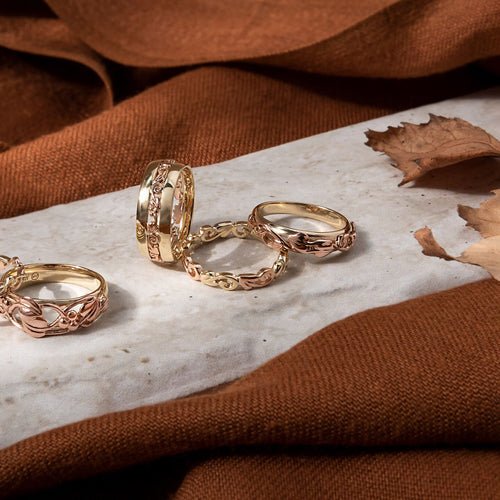
Add up the hours. A ring comes off for washing up, a bracelet for typing, a watch at night. Earrings go in first thing and stay in until the light goes out, often for weeks without being touched. They are the highest-mileage jewellery most people own, and Clogau builds them accordingly.
That mileage changes what matters. A piece worn for four hours can get away with a stiff fitting or an awkward weight. A piece worn for sixteen hours cannot, because every small annoyance is multiplied by every hour it is in, and the pair that pinches by mid afternoon quietly stops being chosen. Comfort in earrings is mechanical, and it comes down to a handful of components most buyers never look at.
What follows covers those components: post thickness, backs, weight distribution across the lobe and hinge quality in a hoop. It also covers sensitive ears, matching style honestly to the life you have, why tone matters most at eye level, and how to clean earrings, which is a different job from cleaning anything else.
The Piece That Does the Most Hours
Ask people which jewellery they wear most and they usually guess a wedding ring. Ask which they take off least and the answer changes. Earrings go in before a mirror and are forgotten within thirty seconds, which is the point of them and also the reason they get chosen carelessly.
A pair therefore survives things nothing else does: showers, gym sessions, a handset pressed against them, jumpers pulled over the head, being slept on. Anything with a weak joint, a soft post or a back that loosens will announce itself within a month. Clogau’s earring range covers a good deal of ground in weight and construction, and the sensible way through it is to work backwards from that daily reality rather than forwards from a photograph.
Posts, Backs and the Engineering of Comfort
Post Thickness: The Specification Nobody Reads
An earring post is a wire, and a standard one sits around 0.8 to 1 millimetre thick. Thinner posts slip through a settled piercing with almost no sensation, which sounds ideal until you realise a thin post also flexes, and a flexing post lets a heavy front tip forward. Thicker posts sit firmly in the channel and hold a stud upright, though if your piercing was made with a thinner gauge the fit is snug.
Neither is wrong. Notice which you already wear comfortably, because a change in post gauge is the commonest reason a new pair feels off for no obvious reason.
Backs: Butterfly, Screw and the Ones That Actually Hold
The butterfly back, that small sprung clutch, is the default fitting and it is genuinely good. It goes on quickly, grips by tension, and can be tightened by pinching the loops together. Its weakness is that same tension, which relaxes over years and eventually lets a back walk off in a scarf.
Screw fittings, where the post is threaded and the back turns on, solve that for the cost of a few seconds each morning, and they suit anything you would be upset to lose. Lever backs, hinged and clicking closed behind the lobe, are the best fitting for drops, since they carry weight from behind rather than relying on friction at the front.
Where the Weight Sits on the Lobe
Total weight matters less than where the weight is placed. A stud puts its mass on the piercing channel and spreads the load across the lobe through the back plate, which is why a substantial stud can feel like nothing. A drop hangs everything below the piercing, pulling on the front edge of the hole for as long as it is in.
Discomfort from a badly distributed earring rarely shows up early. It builds, and by evening the lobe feels warm and heavy, which is the signal that the same pair worn weekly for years will stretch the piercing.
A wide back plate helps, since it spreads pressure across more skin behind the lobe, and so does a design that keeps its bulk close to the ear rather than swinging below it. Across Clogau’s silver jewellery there are designs with visual presence and little mass, which is the combination to look for if you have soft or previously stretched lobes.
Sensitive Ears and the Case for Properly Made Metal
Reactive ears are common and usually blamed on the wearer. The cause is almost always the metal. Nickel is the culprit, appearing in cheap alloys and cheaper plating, close enough to the surface to leach out in contact with sweat. The symptom is a tender, itchy lobe that worsens the longer the earring stays in.
Better metal avoids the problem rather than managing it. Sterling silver and properly made gold alloys behave predictably against skin, and a solid piece has no plating to wear through. That is the strongest argument for spending more on earrings than on any other category, since they sit in constant contact with a small wound that never fully closes.
If you know your ears are sensitive, look at the post and the back rather than the visible front. Those are the parts inside the piercing and against the skin behind, and they are exactly where a cheaper piece cuts corners. Anything from Clogau’s gold jewellery range is made to one standard throughout, front and fitting alike.
Studs, Drops and Hoops, Matched Honestly to Your Week
Studs win on practicality by a distance. They do not catch on a jumper, swing into a phone screen or object to being slept on, and small hands cannot grab them. If your week involves young children, a helmet or headphones, studs are the honest answer whatever your taste says.
Drops are the most flattering and the least forgiving. They move, they catch light and they lengthen the line of the face, which is why they photograph so well. They also snag on scarves and tangle in long hair. Owning a pair for evenings is sensible; buying a pair as your only earrings usually is not.
Hoops sit between the two and live or die by their hinge. A well-made hoop closes with a definite click and no play in the joint, the two halves meeting flush with no step you can feel with a fingernail. A poor one develops a wobble, then a gap, then a habit of opening in your hair. The full Clogau earrings collection covers all three formats, and there is no shame in owning studs for six days and drops for the seventh.
Why Metal Tone Matters Most at Eye Level
Nothing else you wear sits at the height of your own face. A bracelet is seen against a sleeve and a necklace against a neckline, but earrings are seen against skin and hair in the same glance as your eyes, so metal tone is read alongside your colouring.
That proximity flatters warm metals. Rare Welsh gold, of the kind used by some members of the British Royal Family for over a hundred years, reflects onto the skin at close range and softens rather than sharpens. Cooler metals do the opposite, which suits some people very well and others not at all. Hold two pieces either side of your jaw in daylight and look at your face rather than the jewellery.
Detail scale follows the same rule. Fine work that would be lost on a bracelet reads clearly at eye level, which is why designs like Tree of Life earrings work well small. The branching pattern still resolves at conversational distance, where a busier design blurs into texture.
Building a Set That Agrees With Itself
Earrings are almost never seen alone. They appear in the same frame as whatever is around the neck, and a mismatch there is more visible than one anywhere else on the body. Getting the two to agree does not mean buying a matched suite, which can look stiff; it means keeping metal tone and finish consistent.
Finish is the part people forget. A high polish next to a brushed or oxidised surface reads as two different metals even when the alloy is identical, because light behaves differently on each. Choosing earrings and a pendant from the wider Clogau jewellery range sidesteps that, since the finishes are worked to a common standard.
Scale needs a decision too. If the pendant is the statement the earrings should be quiet, and the reverse holds as well, because two loud pieces compete and neither wins. Pairing a substantial pendant from Clogau’s necklaces and pendants with a restrained stud is the arrangement that works most reliably.
Cleaning Earrings, Which Is Not Like Cleaning Anything Else
Earrings need cleaning more often than the rest of your jewellery and get it far less. The post spends its life inside a piercing collecting skin cells and sebum, and the back collects the same behind the lobe. That residue causes most of the irritation people put down to metal sensitivity. A weekly wipe of post and back with surgical spirit on cotton wool, dried fully before wearing, prevents nearly all of it.
For the fronts, warm water with a drop of washing up liquid and a very soft brush works well, with attention to the underside of a stud where it meets the lobe. Rinse properly, since detergent left in a crevice sits against skin all day, and dry with a soft cloth rather than tissue, which sheds fibres into settings.
Store them as pairs rather than loose in a dish, because the commonest way to lose one earring is to put both down separately. A compartmented box keeps them together and stops posts scratching the polished faces of other pieces. Close hoops before putting them away, since an open hinge is the one most likely to be caught and bent.
Conclusion: The Pair You Forget You Have On
The best pair you own is the one you have to check for in the mirror because you cannot feel it. That is not luck. It is a post that fits your piercing, a back that holds without pinching, and weight placed where the lobe can carry it for sixteen hours.
Style still matters, and so does the material. Welsh gold is finite, the Clogau St David’s mine at Bontddu having last closed in 1998, and the tone it brings at eye level is a genuine advantage. Both only pay off on a pair that actually stays in.
So handle the fitting before you fall for the front. Check the hinge, look at the back plate, and be honest about whether your week suits a drop. Get those right and a pair of Clogau earrings will do more hours than anything else you own.


More Stories
2024’s Boldest Fashion Retail Trends: Where Tech Meets Trendsetting
The Runway Meets the Retail Revolution: 2024’s Must-Follow Fashion Trends
Fashion Forward: The Latest Trends Reshaping the Market in 2024